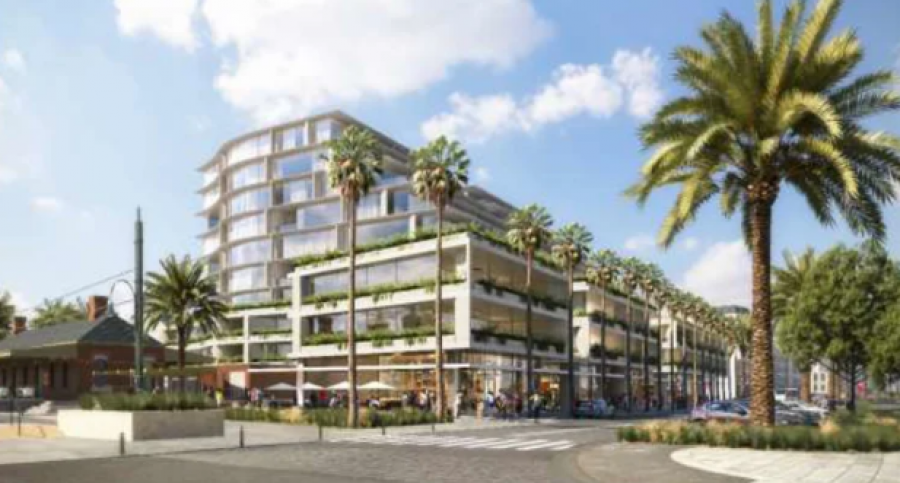
On 24 June, the Port Phillip Planning Committee released their 97-page report regarding an application for the construction of a 10 story building with 119 apartments, retail shops including food and drink premises, a wellness centre, gymnasium and a reduction in car parking requirements. The location at 1-7 Waterfront Place, Port Melbourne, has significant Beach Street frontage.
The report makes for interesting reading for the breadth of considerations, objections and Planning Officer’s responses and conclusion methodology. I shall leave it to you, the reader - who is likely local to this development - to draw your own conclusions regarding two matters that stand out:
- The Planning Officer's conclusion with respect to parking: and
- The Planning Officer's process for conclusion with respect to shadows.
Parking
The report states: “The development is not considered to result in a significant impact upon the road network. The development would provide parking spaces in excess of the requirements of the Planning Scheme. However, due to the way parking would be allocated (no parking allocated to customers of the commercial uses), a parking waiver is sought for the customer component of the parking requirements. The parking waiver is well justified and not considered to result in any undue offsite impacts.” 2.10, page 2
After reading this report, I visited Bay St, Port Melbourne. Bay St is one of jewels of Port Melbourne, with a bustling retail trade. It is very clear that the retail shops on Bay St do require car parking spots for their customers, and due to the strip's popularity, it can sometimes be difficult to find a car parking spot.
It is difficult to reconcile the council's position that retail facilities at Waterfront Place do not require additional car parking (page 49). The report asserts that the retail outlets will only service users who are “typically be in the area already, rather than driving to the Site”. Does this mean walking distance from their home? One must wonder if the future retail tenants will be willing to pay significant commercial rents in an area that only services the population in the building and residents within walking distance. Hopefully, this will not result in untenanted retail shops which will bring a ghost town feel to this new development.
It is also puzzling that council asserts that no visitors parking permits will be required and thus will not be available to any of the 119 dwellings (page 15 Permit Notes): "The owners and occupiers of the new dwellings allowed by this permit will not be eligible for Council resident or visitor parking permits."
Furthermore, and more importantly, it seems the developer is not required to make provision for visitor parking. One can only assume the Planning Officer is of the opinion that all residents will have very limited social life and no carers tending to their needs.
Shadows
The requirement for this building is that "Development should minimise overshadowing beyond the southern kerb line of Waterfront." (Requirement B8 page 75).
The Planning Officer's response to the proposed design is:
- "A detailed assessment in terms of winter shadows has been provided at section 13.4 of the Report; ultimately, they are considered to be acceptable." (page 52)
- Firstly, it is noted that the requirement is discretionary, stating that development should minimise overshadowing. Secondly, whether shadows are ‘minimised’, is ultimately a matter of judgement. It is clear, based on the planning controls, that a 10 storey development which delivers medium to high density housing has been contemplated for the Site, it is within this context that the term ‘minimised’ must be viewed. (B8, page 70-71)
- Furthermore, it must be acknowledged that some level of shadows are inevitable from any development, particularly one of 10 storeys in height (B8, page 70-71)
To this observer, the reasoning offered by the Planning Officer (in bold) does not contribute to the veracity of conclusion reached by the Planning Officer.
As is usual with planning applications, often the most sensible observations come from the general public. One astute objector responded: “...Reiterated concerns relating to winter shadows. In addition, bike and pedestrian paths along Waterfront Place are predominantly in shadow between 9 am and 3 pm at the June solstice, this is not consistent with the requirements of the DDO. …" (Public Notification/Objections, page 52)
So what did the Planning Officer recommend?
Planning Officer's Recommendation
RECOMMENDATION PART A, page 3
"3.2 That the Responsible Authority, having caused the application to be advertised and having received and noted the objections, issue a Notice of Decision to Grant a Permit."
"3.3 That a Notice of Decision to Grant a Permit be issued for the use and development of the land, to carry out works and construct a 10 storey mixed use building over two basement levels, in a shared podium and two tower arrangement, comprising dwellings, retail (shop, food and drink premises, wellness centre), a restricted recreation facility (gymnasium) and a reduction in car parking requirements at 1 & 7 Waterfront Place, Port Melbourne."
The recommendation leaves one scratching one's head, wondering whether common sense has left council buildings. I parked my car outside the future site of 1-7 Waterfront Place, and had one final bask in the sunlight, before both the carpark becomes unavailable, and the sun is blocked out by yet another oversized development lining Melbourne's prime real estate.
Note: Page references cite PDF page numbers, not page numbers displayed lower right in document.
Author's Note: The Planning Officer's responses cited and referenced above are but only a subset of their considerations detailed in the 97 page report.

After hoons took over Marine Parade in January 2021, Council promised to act, but solutions to prevent hoon driving may not be available in time for summer.
Hoon driving is an unfortunate and frequent occurrence along Port Phillip's foreshore, especially in summer. From St Kilda to Port Melbourne, residents have reported hoon driving, antisocial behaviour, violence, excessive noise, and property damage. The dangerous driving has compromised the safety of pedestrians and other vehicles, and has had a detrimental impact on residents and on community safety.
The most notable recent example was in January 2021. St Kilda witnessed hundreds of people gathering on Marine Pde outside the BP service station to watch burnouts. The crowd quickly turned violent with bottles and rocks being thrown including at a police car trying to break up the group. Police later raided homes from Dandenong to Hillside suburbs, arresting 14 people and seizing 12 cars.
Video footage from the St Kilda hoon driving incident can be viewed here: https://youtu.be/NrmLTPrZ7Ck
At the time, Port Phillip Council promised to help prevent similar episodes by deploying CCTV cameras for police use. A community petition was presented to Council in February, and Council decided to seek funding from State Government, in a joint application with Port Phillip Police, for the purchase of a mobile CCTV camera. Council also applied to the Department of Transport to have six fixed cameras installed.
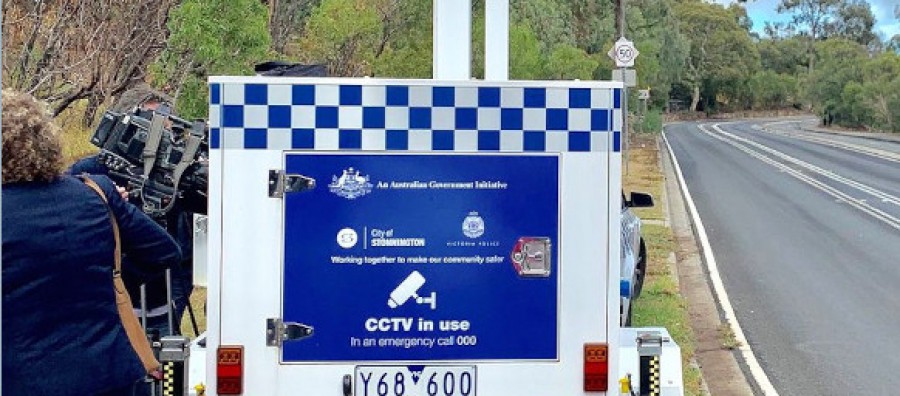
In June, the state government rejected the application, so Council borrowed and trialled the City of Stonnington’s camera (pictured) which was found to be effective in assisting police to identify, locate, and respond to hooning. Council submitted a grant application to the Federal Government in August, but the outcome of the grant application will not be known until October.
The Port Melbourne Road Safety Group (PMRSG), concerned about the lack of progress, presented another petition to Council in August, and at the September 15 Council meeting the petition was considered. 7 of 9 councillors voted for better surveillance, reduced speed limits, physical barriers, new signs and parking restrictions.
FOR: Crs Crawford, Cunsolo, Bond, Sirakoff, Martin, Pearl and Clark
AGAINST: Crs Baxter and Copsey
Two Councillors voted against the motion stating different reasons for their vote. Cr Copsey did not want to spend the money. Cr Baxter cited many reasons including: “nobody else in Port Phillip has even told us what they think that they could be surveilled anywhere, anytime by a mobile piece of equipment" and “we can’t give police everything they want”.
Conversely, Cr Clark supported this motion, stating this issue had been raised many times by residents, councillors and police over the past year, and the community was tired of waiting for action as summer approaches again. Cr Pearl thanked the police for their service to the local community, and local community groups for promoting mobile CCTV to reduce hoon driving and anti-social activity. He acknowledged this is not council's primary function but stated that if the community is asking Council to look at this issue then Council should partner with state government and police to deliver the much needed equipment.
A mobile CCTV trailer would cost $117,120, with an additional $5,000 per annum required for maintenance, insurance, registration, and data costs. This amount would be a rounding error in the City of Port Phillip budget, yet make an enormous difference to the local community and improve community safety.
The City of Melbourne operate a Safe Cities Camera Program which involves 65 CCTV cameras with an additional 315 cameras funded by state government after the Bourke St incident in 2017. City of Melbourne employs specially trained security contractors to monitor the cameras, record incidents and pass information onto police. They also operate a security patrol vehicle that is fitted with 360 degree CCTV surveillance cameras on weekend nights.
Council has dithered on this issue since the events of last summer. A recent interview of Mayor Louise Crawford with ABC’s Virginia Trioli confirmed that Council has no definitive plan to stop hooning this summer, despite it being debated in chambers 8 months ago. No-one wants to see more hoon driving along Marine Parade this summer, and no one wants pedestrians and the community to be put at risk. With hindsight, Council should have budgeted for the acquisition of a mobile CCTV camera given the risk that the grant applications failing.
It is clear most councillors are supportive of community safety and neighbourhood amenity, Residents should demand that Council purchase a mobile CCTV if the Federal Government rejects Council’s application, so that this summer, our roads can be a safe place for our community to unwind after a tough year for everyone.
Image of the City of Stonnington and Victoria Police mobile CCTV trailer:
https://sen.news/2019/10/11/city-of-stonnington-seeks-cctv-access-control-services/city-of-stonnington-mobile-cctv-trailer/