by Dean Hurlston
Your local council typically employs many hundreds of staff
These staff work across many areas including pools, parks, libraries, elderly in home support, youth services, maternal health, rubbish collection, customer service, roads, planning and so much more.
The local government sector is underpinned by a highly “unionised” workforce typically represented by the Australian Services Union (ASU).
Councils are now struggling to manage these staff costs and provide efficient and cost effective services. According to Simon Hammersley from the ASU, there are 30 of Victorias 79 Councils with outstanding EBAs. Some staff haven’t had pay rises in 2 years.
So where to?
Councils have started outsourcing pools and aquatic services already where their own staff earn about $30 per hour and in the contractor space the non unionised award rates are half this!
Elderly in home support services and meals on wheels are now on the chopping block. Federal funding used to be given to councils in advance, based on population not usage. This enables councils to perform services for a very low subsidised rate (typically $6-10 per hr)
Councils have been banking millions in grants in this area for years due to low usage numbers.
Now that the federal govt has moved to a pay in arrears model (based on usage) councils are fast dumping the service and referring to an outsourced external provider. This will dramatically push up the support costs for those who need in home help to remain in their home. Some costs will go from $10hr to $55+ per hour.
We already have a shortage of nursing homes. This will further marginalise low income senior members of our community that have been able to remain in their homes with this low cost support. It will place pressure on nursing home availability and place pressure on families with elderly members living alone.
What’s next? Maternal Health? Libraries?
Council staff cross skilling is needed in the short term.
Some councils like Hobsons Bay have recognised this and recently agreed to cross train their librarians in general customer service.
This helps spread the wage cost and is an efficient practice. Sadly librarians are out in force protesting despite their reasonably high salaries. They are asking the ASU to help them prevent any other duties be added. It must be exhausting for librarians to answer general enquiries from residents in their libraries.
Why are the council staff so opposed to anything but the status quo?
There are many anecdotal stories across the sector of council staff working less hours a day than most of us or knocking off early on a regular basis This is especially in non office based roles. Combine that with relatively high pay rates and no wonder council can be a dream job for some.
When local government is paying staff 2-3
Times the award rates of private enterprise is it actually time to deregulate local
Councils and turn them into nothing but outsourced contract providers for the best service and cheapest cost?
Have councils literally made themselves ultimately redundant because their costs models are no longer fit for purpose and competitive?
Is it time we forced council executives to find cheaper, market based solutions to their overpaid in-house staff?
I guess ratepayers and residents paying rates and fees would certainly hope so!

by Dean Hurlston
There is little doubt that January 26th is a difficult day for indigenous persons around our Country, but is the obsession of local councils to abandon traditional Australia Day celebrations warranted?
This week saw Melbourne Lord Mayor Sally Capp and her fellow Councillors raise this as one of the most important issues for the City of Melbourne. A city, that has office occupancy hovering around 25% and businesses begging for help. A city inundated with homeless and drug dealing almost on every corner, a city swamped with closed shops and graffiti, litter bins overflowing, and a sad sense that it will never be the same. There are over 18,000 small businesses in the City of Melbourne – why isn’t the Lord Mayor and her elected team firmly focused on them?
The mind boggles.
Victoria has 79 local Councils, each raking in their share of the industry's $12 Billion in revenue annually. Amidst the myriad of services – think pools, libraries, rubbish, parks, sporting facilities, and the like, councils claim to provide 25% of all services to their local communities and complain that rate capping is hurting their ability to offer “more services to expanding populations”.
So, before we tackle the Australia Day issue, let's get some things clear. Councils may claim they provide 25% of services with only 4% of the national taxes flowing to them but what Councils fail to acknowledge is that both State and Federal Governments provide Health, Transport, Roads, Infrastructure, Education, NDIS, National Security, Military, and Welfare just to name the main spending categories at a tune of many, many hundreds of Billions per annum. Councils simply provide localised and very small amounts of neighbourhood services. Very small indeed.
So, whilst complaining about their lack of revenue it strikes me as odd that they continue to insert themselves into Nuclear Disarmament, Rainbow accreditations, Climate Change, Bike Lanes in the middle of roads, Electric Vehicles, and the National Day of Celebrating all things Australia, when these are clearly driven by national or state policymakers.
Why is this such an important issue to your local council?
Well just like adding pronouns to their email signatures in a tokenistic attempt to appear as “big players” in being LGBTQI+ inclusive Government, they are now hellbent on forcing local communities to endure an ideological change that really belongs as a state or national conversation. A ideological agenda that is fuelled by tokenistic confected white guilt.
Australia recently elected a new federal government, this is in their wheelhouse not councils!
Its far more appropriate that Councils get back to their core remit of Roads, Pools, Parks, Libraries, etc and great customer service which has been declining rapidly. With such low amounts of our taxes shouldn’t they be trying to reign in costs and be efficient?
Could it be that in trying to be bigger fish than residents and ratepayers ever asked them to be, Councils are trying to be all things to everyone?
Are they just trying to play BIG GOVERNMENT and make themselves more important than they are? Is it why councils are demanding that they get representation at the federal national cabinet level?
I sure think so, and so do the thousands of talkback radio and newspaper readers commenting online. A quick review of these calls and comments highlights one thing – the Councillors and Executives of local councils are fast losing the trust of people in the streets and neighbourhoods. The majority that pays their $12 Billion in revenues each year are starting to be sick and tired of this ideological, cultish obsession.
Put simply, ordinary Victorians have had enough of being lectured to and their Council preaching the new gospel of virtue to them. Instead, Victorians want a Local Government System free of corruption and influence, that charges FAIR rates for services and lets the community be heard first and foremost. A system designed to let the people and their needs drive it, instead of the other way around.
They are tired of Councillors failing to represent the actual communities’ interests but pursuing their own ideological world views. All of this at the expense of overdevelopment of our suburbs whilst our rights are usurped, challenged, and thrown in the bin. Don’t even start us on the mess that is the complaints systems within Councils. You’ll know if you have recently tried to complain to your council that it is often a futile, frustrating, and overwhelming exercise.
Gone are the days when ordinary people mattered, nowadays our Council is only interested if you are a minority that can share your race, stated sex, sexuality, or climate agenda as a badge of honour, and if you happen to use pronouns on your email – you more than likely will jump ahead of the queue. These identifiers look fantastic on their their forms and surveys, because they show the council to be hip and fully inclusive indeed.
Councils really have gone off the rails, but like all things, eventually, the people will put a stop to this. Councils always underestimate the power of the people.
So back to Australia Day, I’ve asked several Council CEO’s how this is helping the real issues of indigenous poverty, abuse, and health outcomes………. needless to say, I am still waiting for any response.
Yet Councils unashamedly claim this is one of the most pressing local issues they need to address without delay.
So why did Sally Capp blast our airwaves and TV screens this week but not mention any of the 18,000 businesses she is meant to be supporting?
Maybe there is no media mileage in them, but there sure is in bagging Australia Day and doing it with your personal Pronouns to boot.
Don’t get me wrong , we need to fix indigenous issues properly. But this will not be done by our councils cancelling Australia Day. It will be done by individuals who spend time in indigenous communities tackling the high rates of abuse, substance and alcohol issues whilst educating and training people to help them lift their communities out of poverty.
If only councils understood that. Silly councils.
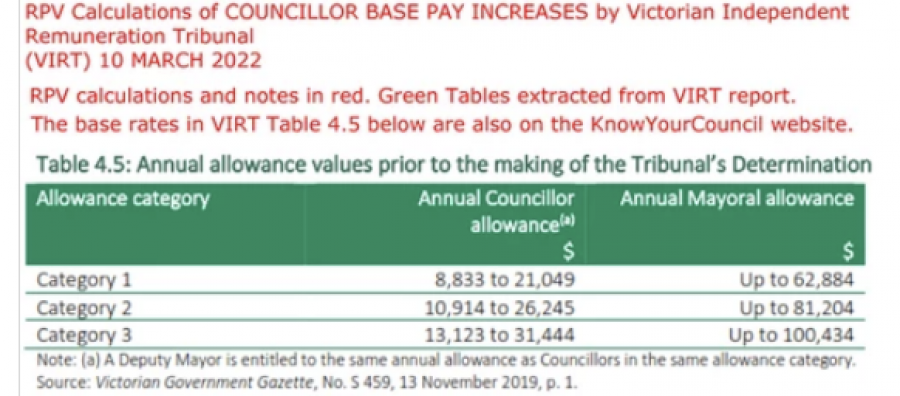
Last week (March 10 2022) homeowners across Victoria vented furiously in media forums against a generous 14% pay rise dished out to Councillors across Victoria by the Victorian Independent Remuneration Tribunal (VIRT).
As the dust was settling, some media and Councillors queried my calculations of 14% payrises for Councillors – saying the rise was really only 4%. (This is still nearly double the average Victorian wage rise but apparently nowhere near as outrage-inducing.)
So here is the explanation: the difference is 10% superannuation.
Because Councillors are not employees they are legally not entitled to superannuation.
In fact, VIRT's own Consultation paper for this Determination clearly stated that because Councillors are not employees, they are not entitled to superannuation:
The SG Act excludes Mayors and Councillors across Australia from the definition of ‘employee’. This means that Councils would not ordinarily be required to pay the SG contribution to Council members. Section 12(9A) of the SG Act states that: a person who holds office as a member of a local Government council is not an employee of the council.
However, the Australian Taxation Office does allow Council members to re-direct their allowances to superannuation on a pre-tax basis if they wish to do so. In addition, each Council has the option to resolve to become an Eligible Local Governing Body (ELGB) under the Taxation Administration Act 1953 (Cth). Where a Council has made such a resolution, Council members are considered to be employees for a variety of taxation purposes and for the purposes of the SG Act.
Since 2008, an amount equivalent to the SG contribution is paid to Council members in those Councils that have not resolved to become ELGBs. This followed a recommendation of the 2008 Allowances Review which noted that: For those who forgo income and/or employment to participate in local government the loss of superannuation has been identified as a significant issue. This can become a barrier to participation for both existing and potential Councillors.
As a result of the factors above, the Tribunal understands that all Council members receive either an SG contribution or an amount equivalent to the SG contribution in addition to their allowance.
Following the rationale above, Councillors were not legally entitled to superannuation, but they wanted it, so Councils found a way to pay it and over the years it has become ‘custom and practice’ and has now been entrenched by VIRT, by way of the Local Government Act changes, voted for by all but a few astute MPs. (Every ALP and Liberal Party MP supported the Local Government Act which handed Councillor pay to VIRT, and voila now superannuation for Councillors is now legalised.)
Councillors will say that they’ve been paid the superannuation since 2008 so it’s no big deal that it’s now officially legal.
The big deal is that it’s been secret.
And since the Know Your Council website and VIRT’s own published base pay figures exclude the 10% superannuation, I retain the right to be outraged that Councillors are now being given a 14% per cent pay rise, courtesy of State MPs and VIRT.
Any Councillor that wants to stand up publicly and announce they’ve been accepting wangled superannuation payments on top of these ‘official’ base pay rates is welcome to speak up.
Verity Webb - RPV Committee member